Navigating UK New Driver Rules (Why Black Boxes Aren’t Enough)
Share
Field Guide 01:
UK New Driver
Compliance.
Status: Legislative & Scenario Briefing
AUTHOR: Robert Olley, Founder & Systems Architect
TARGET SUBJECT: Parents of Newly Qualified Drivers (17-19)
Operational Summary
Passing the UK driving test is merely the initiation phase. For the first two years, newly qualified drivers operate under the strict parameters of the Road Traffic (New Drivers) Act. While parents heavily rely on telematics (black box) insurance and the threat of penalty points to enforce safety, these are passive deterrents. They do not prevent accidents, nor do they assist a 17-year-old stranded with a catastrophic tyre failure. This briefing outlines the legal realities of UK roads and why physical incident response hardware is mandatory to maintain compliance and preserve life.
Phase 1: The 6-Point Guillotine (GB Legal Baseline)
In England, Scotland, and Wales, the probationary period is absolute. Accumulating just six penalty points within the first 24 months of driving results in immediate licence revocation. There is no appeal; the driver reverts to learner status and must retake both the theory and practical tests.
- Mobile Device Strict Liability: A single instance of holding a mobile phone while driving—even while stationary in traffic—yields an instant six points. The licence is revoked instantly.
- The Tyre Trap: Operating a vehicle with defective or critically under-inflated tyres is a severe offence. The penalty is three points per defective tyre. A new driver unaware of a slow puncture can lose their licence in a single traffic stop.
Phase 2: The Telematics Illusion (Black Box Blind Spots)
To secure affordable insurance, most 17-year-olds are fitted with telematics trackers. While useful for monitoring driver behavior, parents must understand the operational blind spots of these systems:
- Passive Monitoring: A black box tracks speed, harsh braking, and severe cornering. It will log the exact speed of a vehicle prior to an impact, but it will do nothing to prevent the impact itself.
- Panic-Induced Strikes: If a new driver experiences a blowout on an unlit dual carriageway, their immediate reaction is often to brake violently and swerve—triggering severe black box penalties and potentially losing control of the vehicle.
Phase 3: Hardware as a Legal and Physical Shield
A high-stress mechanical failure directly compromises a new driver’s ability to remain legally compliant and physically safe. Relying on an insurance app or a breakdown service with a two-hour ETA is an unacceptable operational risk. Immediate, clinical intervention is required.
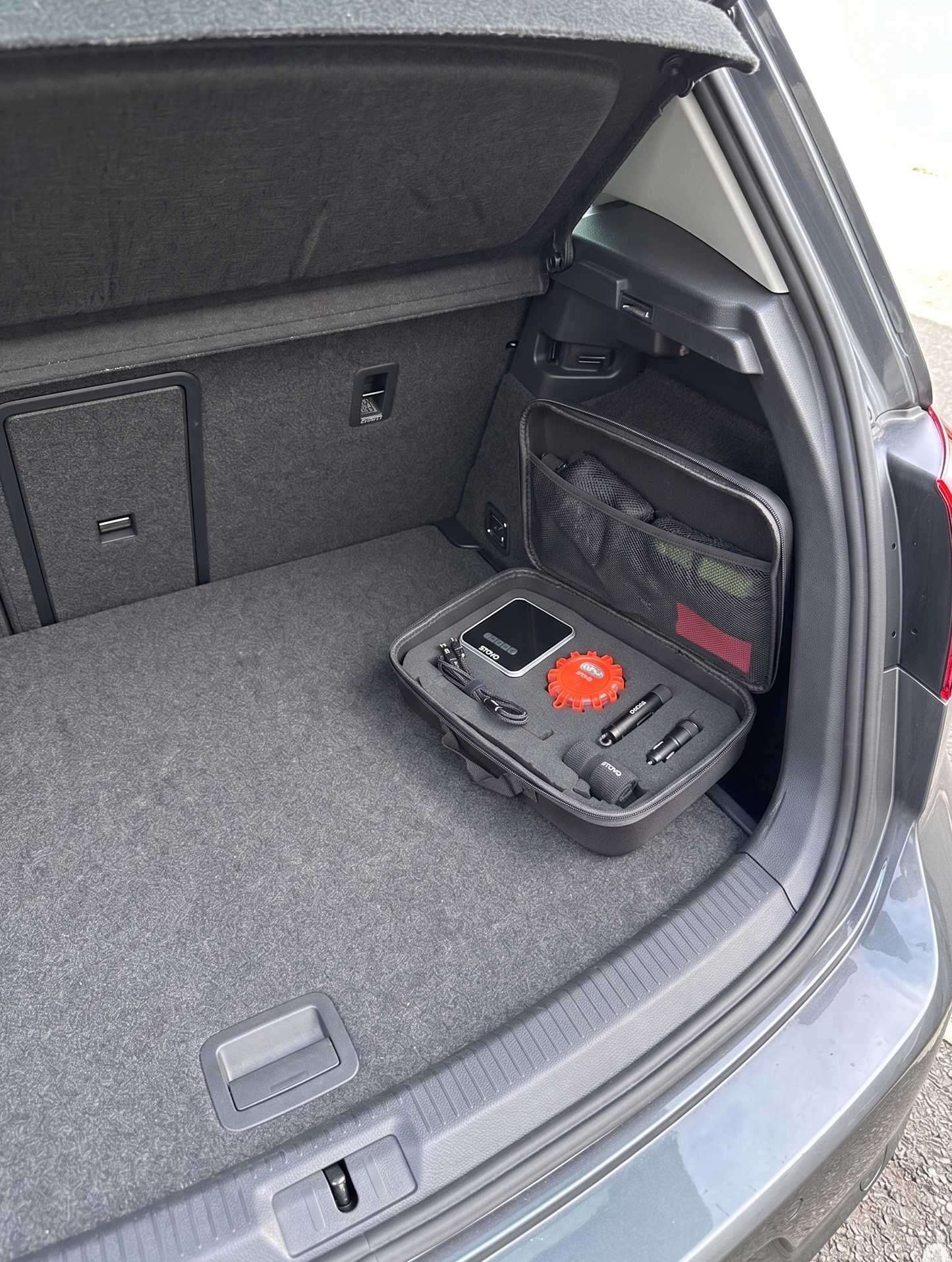
This is where passive monitoring ends and active safety architecture begins. The STOVO Phase 1 System is engineered to systematically eliminate the friction points that cause new drivers to panic, make critical errors, and attract points or collisions.